
 By asasuper
 The most important thing about "adding content" is having content to add! If you have the content, we want to hear from you. There are two ways to add content to the site:
Become a Collaborator/Editor
Write your article using your favorite word processor. Submit the article along with your digital photographs and drawings to the webmaster using email.
Ask a Collaborator to do it for you
Writing the material and getting the pictures ready takes much more time than pasting the text and inserting the pictures on a page. It's literally a 5 minute job to get it on the website. If you are willing to get the text and pictures ready, the webmaster can put it on the website for you.
By asasuper Two people can bring the fuselage to the stand, and that the stand is very stable, making it easy to work on the glider.
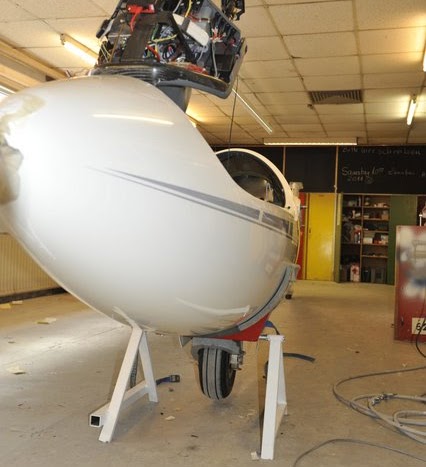
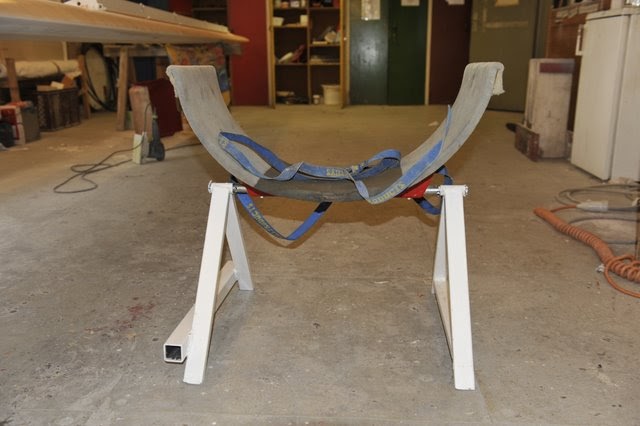
Holger Weiztel
By asasuper The manual advises test-running the engine only when the glider is rigged, tied down, and a pilot is in the glider [need citation]. The manual doesn't give any reasons, but there are clearly some advantages:
At least one pilot has been killed while running engine without rigging; others have had the fuselage tip over or "crawl" into the trailer, resulting in considerable damage and some injury. None of the pilots were ASH 26 E pilots, to my knowledge.
Running the engine is always a serious business, even with the glider rigged, and more so when it isn't.
Given all that, why would anyone want to avoid rigging the glider? Sometimes, it is very convenient to do it where you keep the glider to avoid a long trip to the airport, or do it where you have all the tools and instruments needed to fix a problem.
Here is the procedure I use for running the engine with the fuselage on the trailer ramp. I don't claim it's as safe as doing it with a fully rigged glider, but I believe it's "safe enough" for the three or four times a year I do it. I use a written checklist so I don't forget any steps.
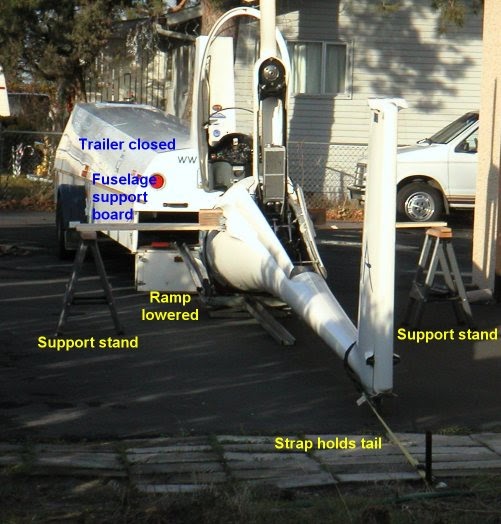
Engine running checklist:
Comments on these steps:
I've always stood outside the cockpit while running the engine this way, but it might be even safer to sit in the cockpit while doing this, while carefully checking the area for other people.
Another way of proceeding...(from Belgium)
The concept I used was based on the one described here above. My fear was that the fuselage could fall on the right or left side on the ground because of the engine vibration level. So I developed a strong wooden structure I could introduce inside the fuselage where the wings should normally come in. The two vertical beams are screwed to the horizontal beam.
Here a picture of the system.
Of course, I strongly recommend to run the engine in static mode with the help of a friend who can look around for security aspects. My experience of this setup is that the fuselage is very stable.
Pay attention that I put some concrete blocks before the wheel and that the glider is up the hill. There is a strong slope before the house that perhaps is not seen on these pictures. In addition, I did run the engine at about 4000 rpm not higher. The objective was only to warm up the engine in winter period without going to the airfield.
By asasuper The Roeger hook, and it's variations, enable a clean jettisoning of the canopy. The hook holds the rear of the canopy to fuselage until the front of the canopy has lifted high enough for the air flow to lift it off the glider. Without this hook, the canopy may "jump" backwards, hit the pilot and injure him, or impede and slow his escape.
Here's an article on the DG site, including videos of some of the testing done by Prof. Roeger. Scroll down half-way for the research project report.
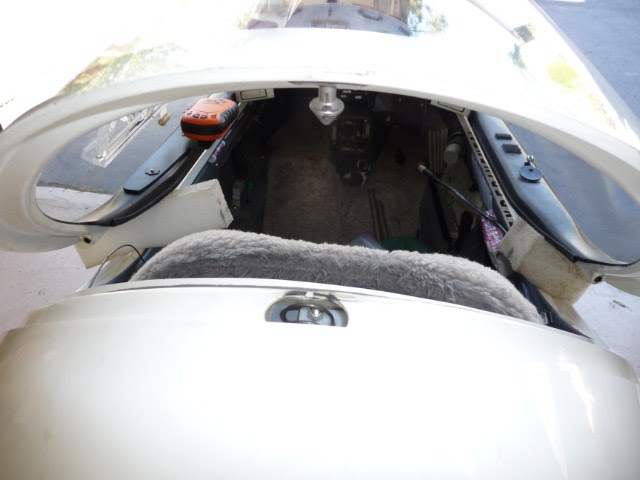
Newer ASH 26 Es are delivered with a Roeger Hook already installed.If you have an older ASH 26 E, please install a Roeger hook for your safety!Schleicher has a kit for this, and the labor wasn't too expensive when I had mine installed in 1998. The picture shows the plunger installed on the canopy, and catch spring installed in the fuselage.
Page 2 of 5